


The Most Data Rich Industry, and One of the Least Connected
Across three days at International Built Environment Week 2026, the AI conversation kept landing on the same prerequisite: data that is clean, standardised and able to move between systems.
Key Takeaways
- The industry has adopted AI. Adoption is no longer the constraint, and the data underneath it is.
- Less than 4% of an organisation’s data is typically used, yet it drives around 80% of workflows. Poor data does not slow AI down. It scales the errors.
- Standards were the recurring answer across sessions with very different agendas. Speakers pointed to CORENET X, the platform used for regulatory approval submissions BCA, as an example where shared data standard is actually running, not just proposed.
- Accountability is not moving. If a professional signs for the data, provenance and validation have to arrive with it.
- Fix your own data first, then connect to the sector. SGBuildex is built for the second step, and at least 70% of Grade A1 builders are already on it.
International Built Environment Week (IBEW) 2026 ran from 2 to 4 September 2026 under the theme “Empowering People, Accelerating Intelligence”. Over three days at Marina Bay Sands Convention Centre, our team sat in plenaries, breakouts and keynotes where Artificial Intelligence (AI) was the subject of nearly every session. In rooms with very different agendas, the discussion followed the same path. It began with what AI can do and arrived, every time, at what AI needs first.
Adoption is no longer the question
The industry is not waiting to adopt AI. It already has.
The Royal Institute of British Architects shared survey data showing that 75% of architects now use AI daily, up from close to zero three years ago. Across Asia Pacific the picture is similar: Autodesk and Deloitte found in 2026 that 46% of construction and engineering businesses across six markets, Singapore among them, now use AI or machine learning tools.1 In his opening keynote, Professor Phillip Bernstein of the Yale School of Architecture noted that roughly 2,000 AI-related tools are now tracked across the architecture, engineering and construction space.
The sharpest line of the week came from the presidents’ plenary: AI will not replace built environment professionals, but professionals who use AI ethically will replace those who do not.
So, the question is no longer whether firms will use AI. It is what they are feeding it.
The most data rich industry, and one of the least connected
That description came from Mr Jefferson Wong, Chief Operating Officer (COO) at DEX, in his Day 3 keynote, and it holds up against everything else discussed during the week.
Consider what one project generates. Main contractors hold programme, productivity, progress, quality and safety data. Consultants and designers hold Building Information Modelling (BIM) models, drawings and technical submissions. Test labs hold results and certificates. Site teams hold records, photographs, checklists and attendance submissions. Sub-contractors hold materials and delivery data. Agencies hold approvals and inspections. Project owners hold asset requirements and monitoring reports.
All of it exists. Almost none of it speaks the same language, and there is no single source of truth across any of it.
There is a structural reason this persists. Projects run for four or five years. Even when firms are willing to invest in integrating their systems, the connections will be dismantled when the project ends, and the next project assembles a different set of tools. So, every project starts that work again from scratch.
Bernstein’s framing of the same problem was more pointed. Information in the built environment is discontinuous. Design concept, detailing, construction and operations each hold their own representation of the same asset, and every handover loses context.
Conversation hits the data
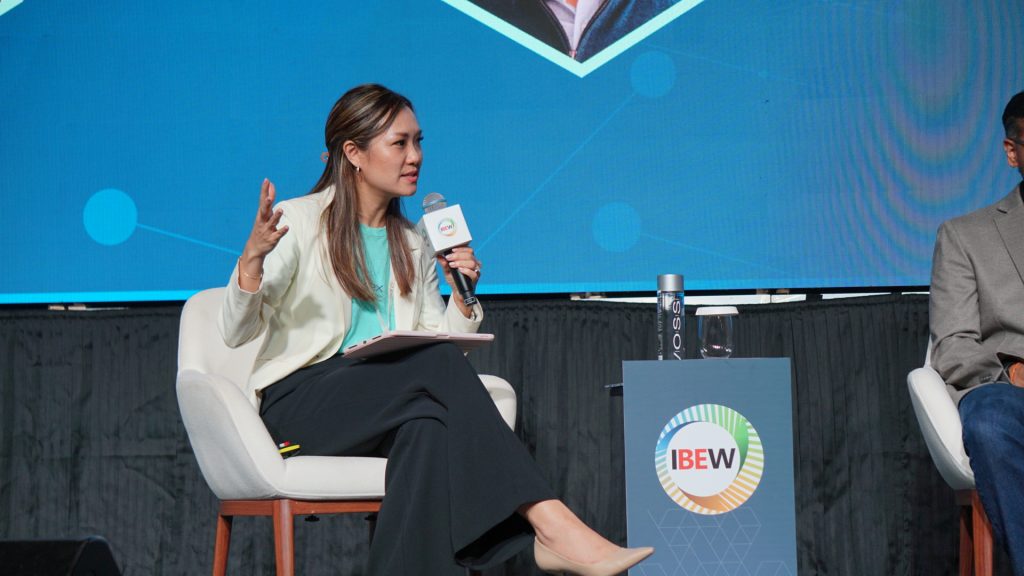
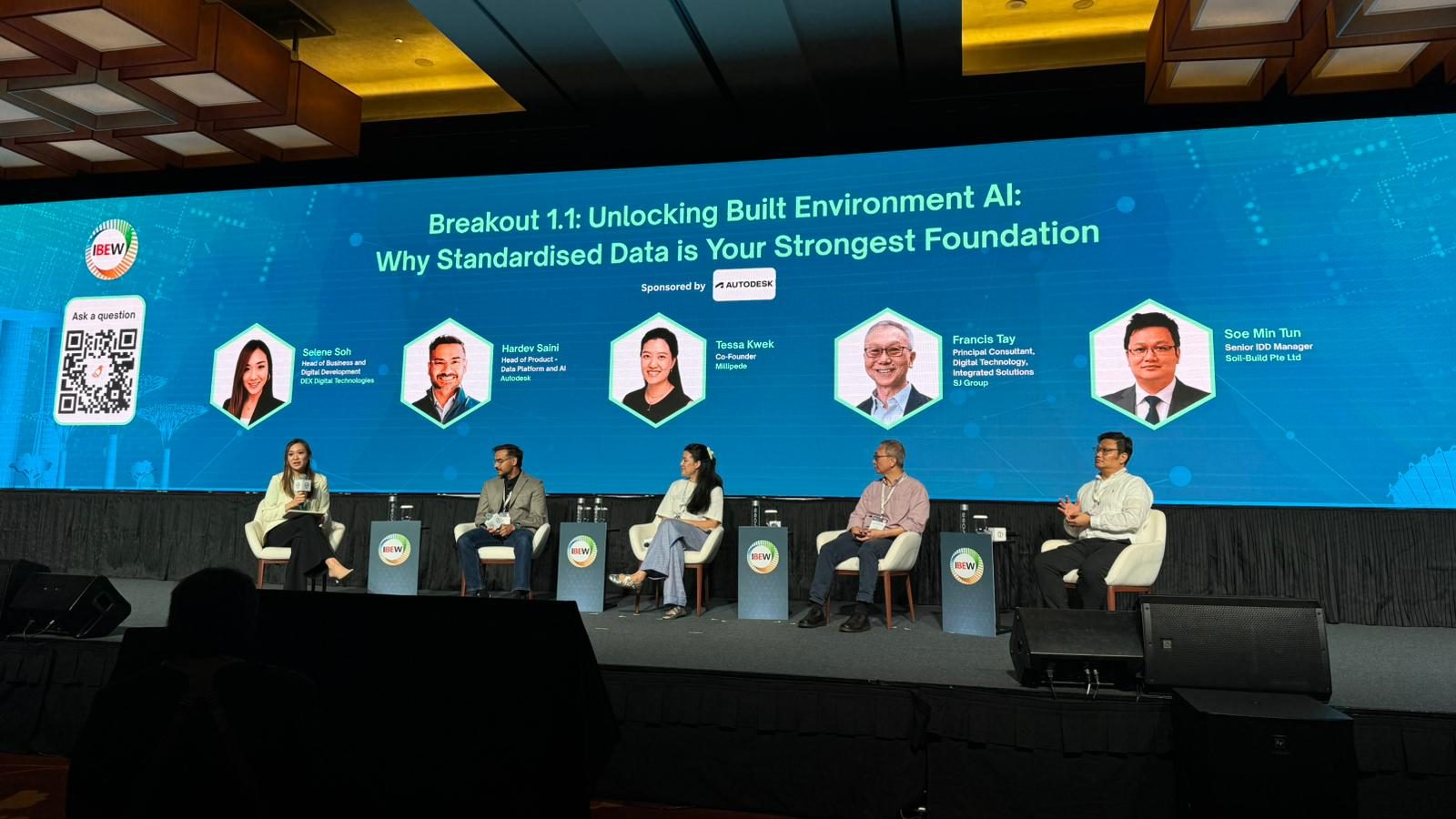
Ms Selene Soh, Head of Business and Digital Development at DEX, moderating Breakout 1.1, “Unlocking Built Environment AI: Why Standardised Data is Your Strongest Foundation”, at IBEW 2026.
The breakout session on standardised data, moderated by Ms Selene Soh, Head of Business and Digital Development at DEX, put numbers against the same problem. Mr Hardev Saini, Head of Product for Data Platform and AI at Autodesk, told the room that less than 4% of an organisation’s data is typically used, yet that fraction drives around 80% of its workflows. Knowledge workers lose roughly 35% of the working week simply locating information. The panel put the annual cost of poor data across the sector in the region of US$5 billion.
One point from that session cuts against the way AI is often sold. AI does not only accelerate good decisions. On poor data, accessible AI is a liability rather than an asset. An AI pilot built on unreliable data does not fail quietly. It produces confident, well-formatted, wrong answers at speed.
Which is why standards kept coming up
Almost every session that got specific about solutions ended up talking about standards. In the plenary on trust and innovation, CORENET X, the platform used for regulatory approval submissions to the Building and Construction Authority (BCA), was described as the world’s first end-to-end mandated common standard. Bernstein went further, saying it was the closest he had seen anywhere to a system that actually keeps building information joined up from design through to operation, rather than just requiring that it should be.
The clearest illustration of why this matters came from Wong’s keynote. Within the BCA and the Housing and Development Board (HDB), RFI means “request for information”. In conversations with the Land Transport Authority (LTA), it emerged that RFI there means “request for inspection”. Same three letters, same industry, different meaning. Now multiply that across every field in every submission.
This is why the Site Management Data Standards published by BCA in May 2025, matters more than it might appear. A shared definition is not administrative housekeeping. It is the precondition for any system, or any model, reading the same data the same way.
Accountability does not transfer
The other recurring theme of the week was liability, and nobody argued it was moving.
Professional bodies are tightening, not loosening. The Institution of Civil Engineers updated its code of conduct in April 2026 to require members to challenge and verify AI outputs, with accountability remaining with the professional. The Royal Institution of Chartered Surveyors (RICS) is preparing for European legislation expected within two years that will require AI outputs to prove where their data came from. The plenary on trust made the same point from the practitioner’s side: Singapore’s new automation standard still requires a named signatory by design.
That has a design consequence for anyone building infrastructure underneath all this. If a person is accountable for what they sign, three things must travel with the data: where each value came from, how confident the system is in it, and a record of what changed along the way.
What this looks like in practice

Mr Jefferson Wong, Chief Operating Officer at DEX, delivering the Track A keynote “From Data to Information to Intelligence” on the final day of IBEW 2026.
Wong framed the whole problem as a renovation. Before anything else, you clear the clutter and fix what is behind the plaster. That is data hygiene: removing duplicates, correcting errors, filling gaps, retiring stale records. That is data hygiene. Then you build to industry specifications, so what you buy fits what is already in the wall. That is common standards. Finally, the house works as one system rather than a dozen apps, because everything connects through a single hub. That is open interoperability.
Skip the first step and you are hanging new cabinets on a rotten wall. The AI renovation looks impressive until the foundation gives way.
Connect Once, Connect All with SGBuildex
Getting your own house in order is the first half. The second half is the part no firm can do alone, because a shared language is worth nothing if only one party speaks it. This is the gap SGBuildex is built for, and the same three principles apply at sector scale.
On hygiene, the work starts with discovery rather than deployment. We work alongside industry players to understand what data they hold, where it lives, what condition it is in and how it should connect. That is an advisory step before a technical one, and it comes first because you cannot standardise or connect a mess.
On standards, we do not impose a schema from above. Common data standards are defined with industry partners and government agencies, anchored on BCA’s Site Management Data Standards, so that a term means one thing across agencies rather than three.
On interoperability, SGBuildex is deliberately solution agnostic. Rather than asking firms to adopt a particular system, it acts as a neutral gateway that connects through the solution providers the industry already uses. As long as your provider is connected, you can exchange data without building a bespoke integration for every counterparty, and without replacing tools your teams already know. That is what Connect Once, Connect All means in practice. At least 70% of Grade A1 builders are already on SGBuildex, with around 40 solutions connected, and each new participant makes the network more useful to everyone already on it.
Two examples show what that looks like day to day:
Industry case: Concrete Cube Test Reports
Concrete cube test reports arrive from labs as PDF documents by email, and someone re-keys them into structured fields. Not every lab can build an Application Programming Interface (API), and we would rather not hold the rest of the value chain back while they catch up. So, using DEXConnect, the reports are parsed automatically into structured values mapped to an agreed schema, each field carrying a confidence score and an audit trail. The lab keeps emailing a PDF. The contractor receives data it can verify before submitting.
Industry case: Manpower Reporting
Manpower reporting shows the other half. Contractors were submitting near-identical data separately to BCA and HDB. Leveraging on DEXWeaver, one unified schema now replaces both, routing each agency exactly the fields it needs. Submit once, distribute many. Neither is glamorous. Both reduce what Wong called the data tax: the daily cost of inefficient data that firms have quietly absorbed for years.
The prerequisite is the point
IBEW 2026 asked the industry to accelerate intelligence. Its own programme kept answering that the acceleration starts further upstream than most AI conversations begin.
Data is raw signal. Information is data that has been structured, standardised and placed in context. Intelligence is what becomes possible after that.
That is the work we are focused on: helping the sector capture data cleanly, agree a common language for it, and move it between systems that were never designed to talk to each other.
As Wong put it in closing, the best time to start was yesterday. The next best time is today.
If you are working out where your own data foundation stands, reach out to our team or explore what SGBuildex enables for firms across the built environment: https://www.dextech.ai/our-dexes/sgbuildex/
Sources
- State of Digital Adoption in the Construction Industry 2026, Autodesk and Deloitte, published 3 July 2026, 954 businesses across six Asia Pacific markets. https://www.deloitte.com/au/en/services/economics/perspectives/state-digital-adoption-construction-industry.html

